












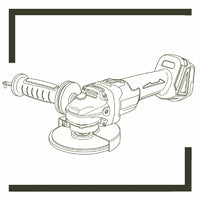

Angle grinder or bench grinder? Choosing the right tool depends on the type of work you need to complete. While both are designed for grinding tasks, they serve different purposes.
In this guide, we will compare angle grinders and bench grinders from five key aspects: purpose, ease of use, material compatibility, safety considerations, and common uses.
What is an Angle Grinder?
An angle grinder is a handheld power tool that uses a rotating abrasive disc to perform various tasks, including cutting, grinding, polishing, sanding, and surface preparation. Thanks to its interchangeable discs and portable design, an angle grinder is one of the most versatile tools for DIY projects, construction work, automotive repairs, and metal fabrication.
What is a Bench Grinder?
A bench grinder is a stationary grinding tool mounted on a workbench. It usually features one or two grinding wheels that rotate at high speed for sharpening, shaping, and smoothing metal parts.
Unlike an angle grinder, a bench grinder stays in one fixed position. Instead of moving the tool, users bring the workpiece to the grinding wheel.
Angle Grinder vs. Bench Grinder: Key Differences
Purpose
Angle Grinder: A Multi-Purpose Tool for Various Tasks
An angle grinder is designed for flexibility. By changing different discs and attachments, it can perform multiple functions, including cutting, grinding, polishing, and surface cleaning.
For example, when repairing metal structures, an angle grinder can cut through materials, remove rust, and smooth rough surfaces without requiring multiple tools.
Bench Grinder: A Dedicated Tool for Sharpening and Grinding
A bench grinder is built for more specialized applications. Its fixed grinding wheels provide consistent performance, making it ideal for sharpening tools and refining small metal components.
If your main goal is tool maintenance or precision grinding, a bench grinder offers better stability and control.
Ease of Use
Angle Grinder: Flexible Operation in Different Locations
Because an angle grinder is handheld, users can easily move around the material and adjust the grinding angle during operation.
This flexibility makes it especially useful for working on large workpieces, outdoor projects, construction applications, and repairs in tight spaces where a stationary tool may not be practical.
Bench Grinder: Stable and Controlled Grinding
A bench grinder provides a stable working platform. Since the grinding wheel remains fixed, users can maintain consistent pressure and achieve a steady grinding angle. This makes it easier for tasks that require accuracy, such as sharpening drill bits or restoring tool edges.
Material Compatibility
Angle Grinder: Suitable for a Wider Range of Materials
One of the biggest advantages of an angle grinder is its ability to work with different materials by using the appropriate disc or attachment.
Depending on the accessory, an angle grinder can handle:
- Steel and stainless steel
- Aluminum
- Tile
- Concrete
- Stone
- Other construction materials
This versatility makes it a popular choice for both DIY users and professionals.
Bench Grinder: Ideal for Metalworking Tasks
Bench grinders are mainly designed for metal applications. They work especially well on steel tools and small metal parts that require sharpening, shaping, or smoothing.
Typical applications include:
- Sharpening cutting tools
- Refining metal edges
- Removing small imperfections
While bench grinders provide excellent results on metal, they are not designed for cutting or handling as many material types as angle grinders.
Common Uses
Angle Grinder: Ideal for Cutting, Repair, and Surface Preparation
An angle grinder is a versatile tool designed for a wide range of applications. Its handheld design allows users to work on large materials, uneven surfaces, and areas that are difficult to access with stationary equipment.
Common applications include:
- Cutting metal pipes, bolts, and steel sheets
- Removing rust, paint, and surface coatings
- Grinding welds and smoothing rough edges
- Polishing and preparing metal surfaces
- Cutting tiles, bricks, and masonry materials
- Handling automotive repairs and construction projects
For users who need a flexible tool for different tasks, an angle grinder provides excellent versatility.
Bench Grinder: Ideal for Sharpening and Precision Grinding
A bench grinder is better suited for controlled grinding and tool maintenance. Its fixed design allows users to achieve accurate and repeatable results.
Common applications include:
- Sharpening knives, scissors, and blades
- Sharpening drill bits and cutting tools
- Smoothing small metal components
- Removing burrs from metal parts
- Maintaining workshop tools
For users who focus on precision work and regular tool maintenance, a bench grinder is a valuable workshop addition.
Which Tool Should You Choose?
The right choice depends on your specific needs and the type of work you perform most often.
Choose an angle grinder if you need:
A versatile tool for cutting, grinding, and polishing
The ability to work on large materials
A portable solution for different locations
A tool that can handle multiple materials
Choose a bench grinder if you need:
Precise sharpening and grinding
A stable workshop tool
Consistent results on small metal parts
A dedicated solution for tool maintenance
For many workshops, having both tools can provide the best of both worlds. An angle grinder handles larger, more flexible projects, while a bench grinder delivers precision for sharpening and detailed grinding tasks.
